Updates
- Apr 2026 Started my Masters in Computer Science program at Stanford
- Jun 2026 Graduated from Stanford with a BS in Computer Science and Music minor
- Sep 2022 Started my undergraduate studies at Stanford
- Nov 2004 Celebrated my first birthday
Research
I am interested in how robots can learn from humans to perform dexterous, everyday tasks in the real world.
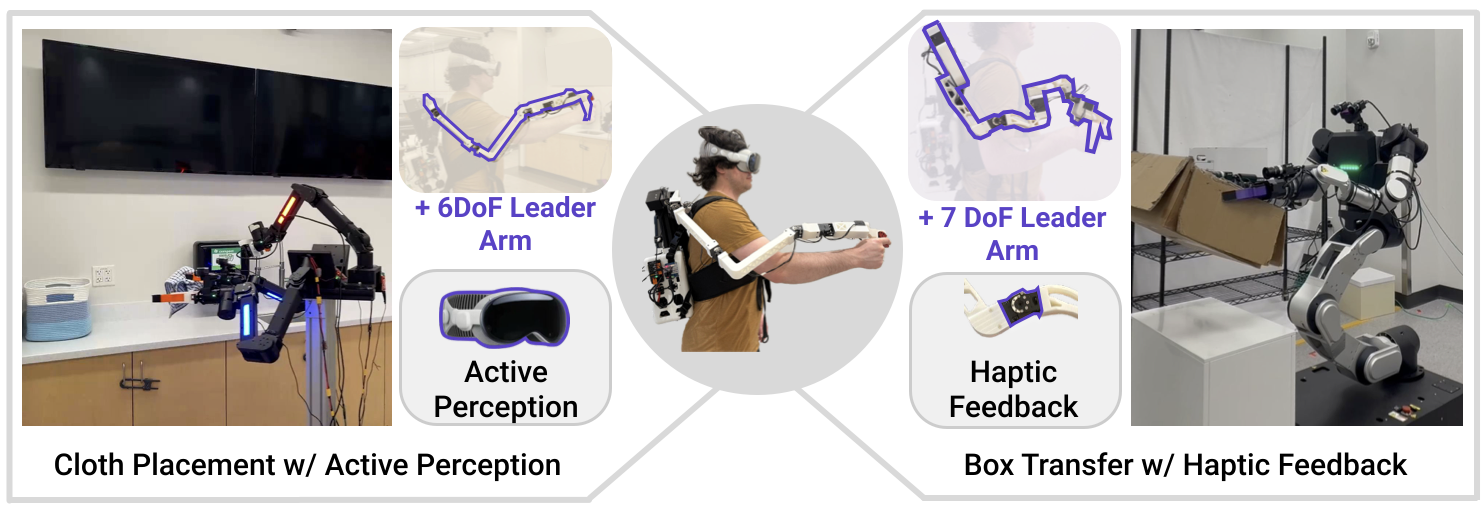 ModPack: An Extensible Teleoperation Interface for Bimanual Mobile Manipulation
Joshua Citron,
Renee Zbizika,
Zeyi Liu,
Shuran Song
Stanford University
arXiv 2026
Webpage •
Paper
TL;DR: A modular wearable backpack teleoperation system with plug-and-play capability modules for haptic feedback, mobile manipulation, and active perception across diverse robot embodiments.
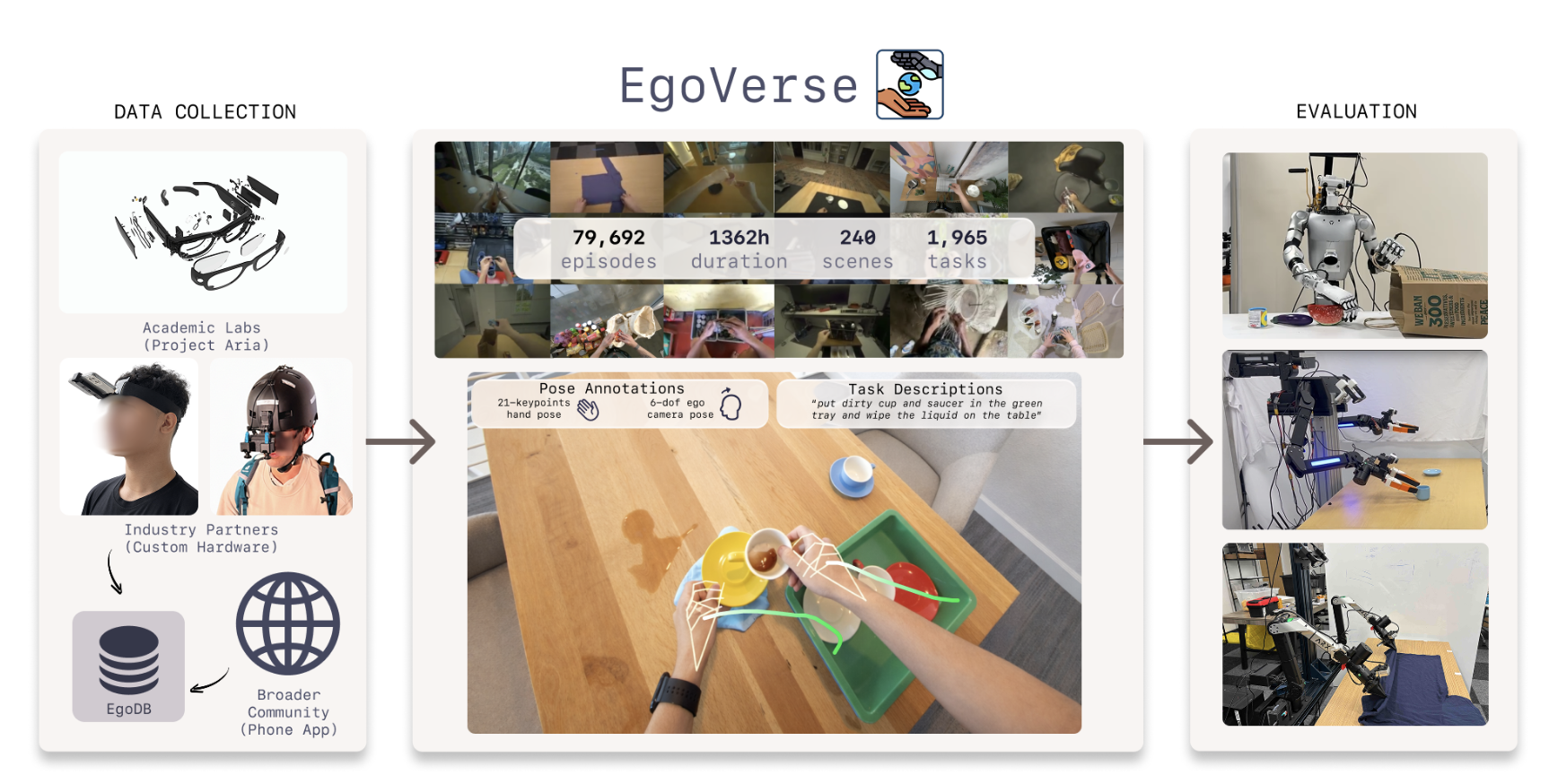 EgoVerse
Ryan Punamiya1,
Simar Kareer1,
Zeyi Liu2,
Josh Citron2,
Ri-Zhao Qiu3,
Xiongyi Cai3,
Alexey Gavryushin4,
Jiaqi Chen4,
Davide Liconti4,
Lawrence Y. Zhu1,
Patcharapong Aphiwetsa1,
Baoyu Li1,
Aniketh Cheluva1,
Pranav Kuppili1,
Yangcen Liu1,
Dhruv Patel1,
Aidan Gao1,
Hye-Young Chung1,
Ryan Co1,
Renee Zbizika2,
Jeff Liu2,
Xiaomeng Xu2,
Haoyu Xiong2,
Geng Chen2,
Sebastiano Oliani2,
Chenyu Yang2,
Xi Wang2,
James Fort2,
Richard Newcombe2,
Josh Gao2,
Jason Chong2,
Garrett Matsuda2,
Aseem Doriwala2,
Marc Pollefeys4,
Robert Katzschmann4,
Xiaolong Wang3,
Shuran Song2,
Judy Hoffman1,
Danfei Xu1
1Georgia Tech
2Stanford
3USC
4ETH Zurich
arXiv 2025
Webpage •
Paper •
Code
TL;DR: A data collection and policy learning framework that learns whole-body mobile manipulation directly from robot-free human demonstrations.
 NOIR-iBCI: Neural Signal Operated Intelligent Robot for Dexterous Manipulation
Wensi Ai,
Ruohan Zhang,
Karthik Dharmarajan,
Nishal P Shah,
Chaofei Fan,
Tasha Kim,
Yunfan Jiang,
Chen Wang,
Alex Hodges,
Renee Zbizika,
Mattia Rigotti-Thompson,
Donald Avansino,
Nick Hahn,
Akansha Singh,
Foram Kamdar,
Payton Bechefsky,
Alexander Acosta,
Lucille Panagos,
Kushaal Rao,
Bayardo E. Lacayo,
Carlos E. Vargas-Irwin,
Nicholas Au Yong,
Chethan Pandarinath,
Leigh Hochberg,
Francis R Willett,
Jaimie M. Henderson,
Li Fei-Fei,
and Jiajun Wu.
In submission to Science Robotics (2025)
TL;DR: A brain-robot interface system enabling dexterous robot manipulation via neural signals from intracortical recordings.